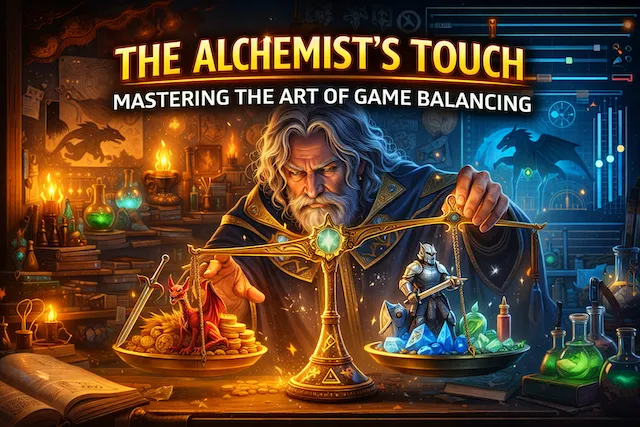
Game balancing. It's the alchemist's touch – the subtle art of transforming raw code and assets into a captivating experience. A perfectly balanced game isn't just 'fair'; it's a meticulously crafted dance of risk and reward, challenge and progression, pushing players to the edge of their skill while keeping them hooked.
But achieving this equilibrium is far from easy. It's a delicate process of iteration, testing, and fine-tuning, demanding a deep understanding of your game's systems, your player base, and the psychological triggers that drive engagement. Neglecting balance can lead to frustration, abandonment, and ultimately, a failed game. This blog post will explore the core principles and practical techniques for achieving a harmonious and engaging gameplay loop.
“Game balance isn't about making everything equal, it's about making every choice meaningful.”
Understanding Your Game's Ecosystem
Before you even begin tweaking numbers, you need a **comprehensive understanding** of your game's ecosystem. This means identifying all the interconnected systems, mechanics, and variables that influence gameplay.
- **Core Mechanics:** What are the fundamental actions players take? How do they interact with the world?
- **Progression Systems:** How do players advance, unlock new abilities, or acquire better gear?
- **Resource Management:** What resources are available, how are they acquired, and how are they spent?
- **Risk/Reward:** What are the trade-offs players face when making decisions?
Once you've mapped out the entire system, you can start identifying potential **balance bottlenecks** – areas where the gameplay loop breaks down or becomes unsatisfying. Common bottlenecks include overpowered weapons, trivial challenges, or excessive grinding.
Tools and Techniques for Balancing
With a solid understanding of your game's ecosystem, it's time to equip yourself with the tools and techniques necessary for effective balancing. Here's a breakdown of some essential strategies:
- **Spreadsheets and Data Analysis:** Track key metrics like damage output, resource costs, and player progression. Use spreadsheets to model the impact of changes and identify imbalances.
- **Playtesting:** Get your game into the hands of real players as early and often as possible. Observe their behavior, gather feedback, and iterate based on their experiences. Pay close attention to both quantitative data (e.g., win rates, completion times) and qualitative feedback (e.g., player comments, frustration points).
- **Iterative Balancing:** Balancing is rarely a one-time fix. Embrace an iterative approach, making small, incremental changes and continually testing their impact. Avoid sweeping changes that can introduce unintended consequences. Consider A/B testing to see which changes are most effective.
- **Scenario Planning:** Anticipate how players will exploit your game's systems and design counters to those strategies. Consider worst-case scenarios and balance accordingly. Create specific test cases to reproduce exploits to make sure your fixes work.
// Example of a simple damage calculation function
function calculateDamage(attacker, defender) {
  let damage = attacker.attack - defender.defense;
  if (damage < 0) {
    damage = 0; // Ensure damage is never negative
  }
  return damage;
}

// This code illustrates the *basic* logic; in a real game,
// many more factors are involved (crit chance, resistances, etc.)
Tools like spreadsheets and code allow us to simulate and model our systems, but nothing replaces real player data. **Data-driven design** is critical.
“The best game balance comes from observation, iteration, and a willingness to kill your darlings.”
The Human Element: Understanding Player Psychology
Balancing isn't just about numbers; it's about understanding the **human element**. How do players perceive fairness? What motivates them to keep playing? How do they react to different types of challenges?
- **Perceived Fairness:** Even if a system is mathematically balanced, players may perceive it as unfair if it feels arbitrary or inconsistent. Ensure that rules are clear, transparent, and consistently applied.
- **Flow State:** Strive to create a gameplay experience that keeps players in a state of 'flow' – a state of focused engagement where the challenge is perfectly matched to their skill level. Gradually increase the difficulty to keep players challenged without overwhelming them.
- **Positive Reinforcement:** Reward players for their efforts, even when they fail. Provide clear feedback on their progress and offer opportunities for improvement. Use positive reinforcement to motivate players to overcome challenges.
By understanding player psychology, you can fine-tune your game's balance to create a more engaging, rewarding, and ultimately, more enjoyable experience. Don't be afraid to adjust balance based on *feel*, not just numbers. Trust your instincts and what your players tell you.
The art of game balancing is a continuous journey, a quest for the perfect harmony between challenge and reward, fairness and excitement. Embrace the iterative process, listen to your players, and never stop striving for that elusive alchemical transformation. The rewards will be well worth the effort.